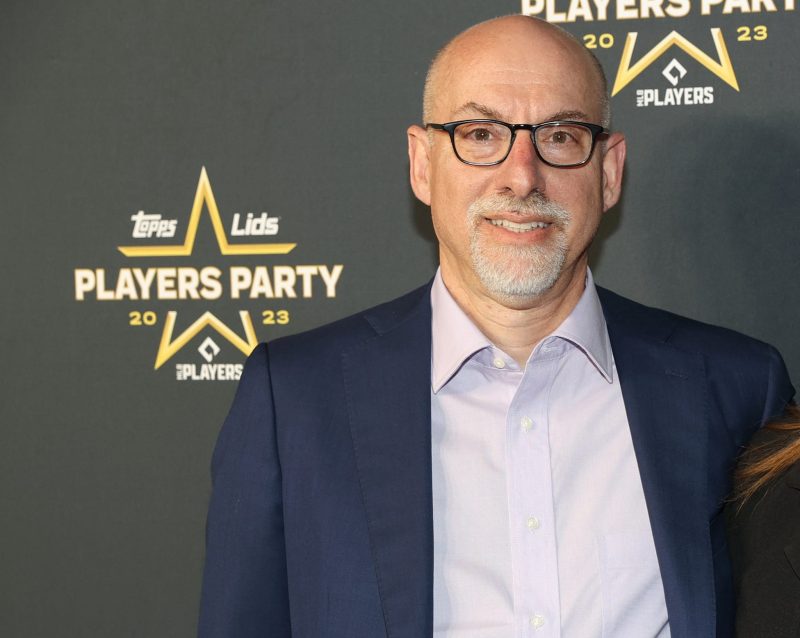
PHOENIX — Bruce Meyer hasn’t even been on the job 24 hours as the new chief of the MLB Players Association, and already he knows he has enemies.

There are some folks who wish he never got the job.
There are MLB executives who hate dealing with him.
There are agents who believe he favors only Scott Boras and other powerful agents.
There are players who think he can be condescending.
Meyer realizes he doesn’t have the personality of his predecessor, Tony Clark. He didn’t play 15 years in the major leagues. He didn’t even play in the minors. He didn’t play in high school.
But, man, can he ever litigate, and as long as he’s on the job, he vowed Thursday in a 30-minute interview to do everything possible for the players to get the best possible deal he can in the next collective bargaining agreement, and at the same time, help heal fractured relationships among agents and players in the game.
Meyer certainly wants to clear up any misperception that he provides preferential treatment to Boras, reiterating that Boras has no more influence on him than any other agent.
“I almost don’t want to dignify it,’’ Meyer said after speaking for 2½ hours to the Milwaukee Brewers. “Scott is an agent. He represents a lot of players. He has no more influence over the running of the union than any other agent. And the continuous suggestions to the contrary − which I believe are mostly originated by the league − are really just an attempt at divisiveness.
“Every agent is valuable to us. Every agent represents players who are our clients, our constituents. Every agent has our ear and we take it all very seriously.’’
It’s no different than the players, he said, trying to assure that the middle class and young class of players benefit just as much as the game’s wealthiest players in the next collective bargaining agreement. It was just two years ago when 21 players tried to lead a coup to have Meyer fired and replaced by attorney Harry Marino, who helped unionize the minor league players, and now he’s responsible for the well-being of 1,200 major-league players.
“You’re never going to have everybody agreeing with everyone,’’ Meyer said. “It just doesn’t happen. … You’re never going to get everybody on the same page, but you try and do the most you can.
“Disagreements are not just expected, they’re actually great. I mean we have very free and frank exchanges of views on all subjects in the past. That’s what these meetings are about. … We want and expect players to express their views, to express their disagreements, to talk it out, and we want to educate players.
“If at the end of the day we are not 100% on the same page, that’s unfortunate, but that’s to be expected. It doesn’t mean we can’t accomplish our goals.’’
Meyer, 64, who was unanimously voted by the union’s executive subcommittee and player representatives to succeed Clark, says while he is honored to be the union’s seventh executive director, he hates the circumstances. He was appointed Wednesday, about 48 hours after Clark was forced to resign after an internal investigation discovered an inappropriate relationship with his sister-in-law, a union employee based in their Scottsdale, Arizona, office.
“I feel for Tony, as we all do,’’ Meyer said. “I can’t say that anybody is celebrating anything at this point. But I’ve been representing players in really all of the (sports) unions for almost exactly 40 years. I’ve dedicated my career to protecting and advancing players rights. It’s something I’ve always been passionate about…
“So, if players believe that I am the best choice to help the union, that’s an honor, and that’s what I’m going to devote all my time and attention to.’’
Meyer’s appointment comes less than 10 months before the expiration of the CBA; a lockout is expected to begin on Dec. 1, with the league expected to seek a salary cap the union is vehemently opposed to. Meyer was going to be the lead negotiator once again, but with Clark gone, his duties will now expand.
Meyer, who was hired by former MLB union chief Don Fehr at the NHL players association, was able to break away Wednesday evening and attend the 2026 Playmakers Classic with Fanatics along with his wife, Jacqueline, and was warmly greeted by players and officials at the event. His phone buzzed all evening and in the morning with text messages and calls from everyone: classmates from middle school to fellow lawyers to Dan Halem, MLB deputy commissioner.
“(Halem) was very nice, very gracious, very classy,’’ Meyer said. “Despite occasional reports of the contrary, we have a good relationship, professional relationship, and I appreciate it.’’
Life will certainly be a whole lot busier for Meyer, who still plans to play the guitar as a stress relief, but his days of performing with buddies in a band may be over. He not only is picking up many of Clark’s duties, along with Matt Nussbaum, who was promoted to Meyer’s previous position, but he is now the new face of the union.
“My focus is going to continue to be on collective bargaining,’’ Meyer said. “I mean, our positions on bargaining aren’t going to be affected.’’
So, just in case anyone had any ideas that Meyer will turn soft in negotiations and suddenly be open to a salary cap, forget about it.
It’s not happening with Meyer in charge.
“We don’t believe in a system that’s basically a zero-sum game,’’ Meyer said, “that says, ‘If we pay you, we got to take that out of the pocket of another player.’ That’s how the other (salary-cap) systems work. … What happens is the top guys get paid and then everyone else gets what’s left over.
“The salary cap doesn’t help players at any level. … Doesn’t help the middle-class players. They get screwed the most in these systems. … And once you’re in that system, the history is that it always becomes worse and worse for players over time.
“We can make improvements for players at every level, in many ways, without going down the road of something that this union has fought against for literal generations.’’
And once again, the union plans to resist any attempt by MLB to eliminate salary arbitration and have it replaced by a statistical system based on pure numbers. Certainly, Detroit Tigers two-time Cy Young winner Tarik Skubal doesn’t win a landmark $32 million arbitration case if the arbitration system is based on analytics.
“Any attempts to eliminate it are certainly going to be viewed with a negative light,’’ Meyer said, “and they have been in the past.’’
Meyer, who still has to meet with 27 more baseball teams in the next three weeks, will attend the World Baseball Classic in place of Clark, and will work on quickly developing relationships with players and agents, which was Clark’s forte.
“Tony has unmatched relationships that he had built as a player, a leader,’’ Meyer said. “Tony had unique skills. We’re going to miss certain aspects of that for sure.
“But I think we are in a very good place in terms of doing everything we can to make sure players are in a very good place.’’
Follow Nightengale on X: @Bnightengale