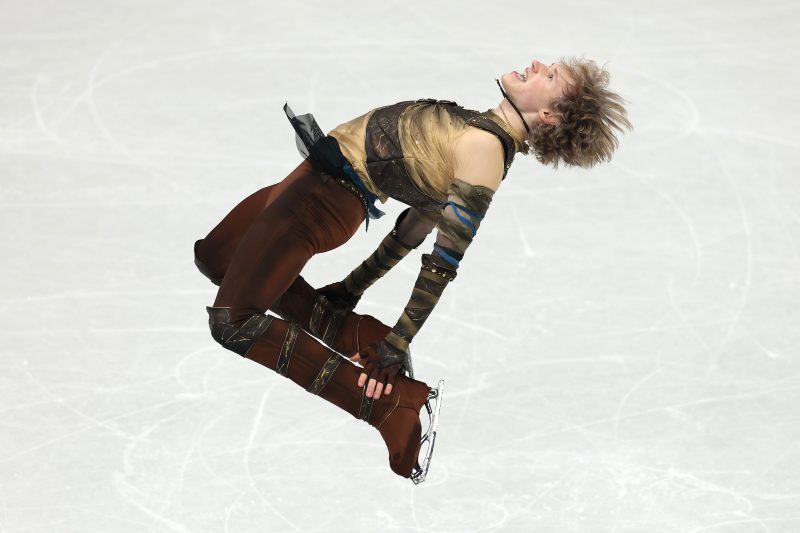
MILAN — The men of figure skating took their first turn in the singles competition at the 2026 Winter Olympics on Tuesday, and ‘Quad God’ Ilia Malinin lived up to the hype with a short program that scored a 108.16 and drew a massive standing ovation from the crowd.

“I definitely felt like I was in a better zone this time,” he said.
The gold medal favorite sits atop the standings entering the free skate on Feb. 13, after which medals will be awarded.
“Having that attention, all those eyes on you, that pressure really shows you who you truly are on the ice,” he said. “It’s another skill to be able to perform it under pressure. I think that’s something I really enjoy.”
Watch Olympics figure skating on Peacock
Teammate Maxim Naumov, making his Olympic debut, skated second in the lineup, scoring a season-best 85.65. In the kiss-and-cry section after, the 24-year-old held with him a photo of him as a 3-year-old with his parents, who died the plane crash that killed 67 people near Washington D.C. just more than a year ago. Fellow American Andrew Torgashev turned in a score of 88.94, putting him in second through Group 3.
The men’s singles competition began just two days after Malinin’s clutch performance earned the U.S. gold in the team event. There were 29 skaters in the field and the top 20 advance to the free skate on Feb. 13, after which medals will be awarded.
Follow along below for USA TODAY Sports’ live results and highlights from the men’s short program.
Ilia Malinin short program
Ilia Malinin screamed in joy halfway through his short program in the men’s competition Tuesday night at the 2026 Winter Olympics. He had just completed his three industrial strength jumping passes without a hitch, including two majestic quadruple jumps. Now he was flying past center ice, and his emotions got the better of him, and he let out a yelp into the icy arena air. He was back, and he knew it.
His score? 108.16 points, a healthy five points ahead of Japan’s Yuma Kagiyama, who had 103.07. With a long program packed with his record-breaking seven quads, Malinin is back to being the strong favorite to win the gold medal Friday night. How things have changed for him since his shaky short program in the team event over the weekend.
Figure skating live results, updates
Here are the standings after the short program of the men’s singles competition.
Ilia Malinin (United States): 108.16 total segment score, 62.35 technical elements score, 45.81 program components score.
Yuma Kagiyama (Japan): 103.07 total segment score, 56.50 technical elements score, 46.57 program components score.
Adam Siao Him Fa (France): 102.55 total segment score, 57.27 technical elements score, 45.28 program components score.
Daniel Grassl (Italy): 93.46 total segment score, 52.73 technical elements score, 40.73 program components score.
Mikhail Shaidorov (Kazakhstan): 92.90 total segment score, 52.45 technical elements score, 40.49 program components score.
Junhwan Cha (Korea): 92.72 total segment score, 50.08 technical elements score, 42.64 program components score.
Kevin Aymoz (France): 92.64 total segment score, 48.55 technical elements score, 44.09 program components score.
Andrew Torgashev (United States): 88.94 total segment score, 48.56 technical elements score, 40.38 program components score.
Shun Sato (Japan): 88.70 total segment score, 46.77 technical elements score, 41.93 program components score.
Stephen Gogolev (Canada): 87.41 total segment score, 48.23 technical elements score, 39.18 program components score.
Kyrylo Marsak (Ukraine): 86.99 total segment score, 49.20 technical elements score, 37.69 program components score.
Petr Gumennik (Neutral Athlete): 86.72 total segment score, 48.43 technical elements score, 38.29 program components score.
Boyang Jin (China): 86.55 total segment score, 47.79 technical elements score, 38.76 program components score.
Maxim Naumov (United States): 85.65 total segment score, 47.77 technical elements score, 37.88 program components score.
Nika Egadze (Georgia): 85.11 total segment score, 45.85 technical elements score, 39.26 program components score.
Matteo Rizzo (Italy): 84.30 total segment score, 42.49 technical elements score, 41.81 program components score.
Deniss Vasiljevs (Latvia): 82.44 total segment score, 42.34 technical elements score, 40.10 program components score.
Aleksandr Selevko (Estonia): 82.02 total segment score, 41.33 technical elements score, 41.69 program components score.
Lukas Britschgi (Switzerland): 80.87 total segment score, 40.61 technical elements score, 40.26 program components score.
Adam Hagara (Slovakia): 80.30 total segment score, 45.17 technical elements score, 35.13 program components score.
Vladimir Samoilov (Poland): 77.57 total segment score, 40.88 technical elements score, 36.69 program components score.
Kao Miura (Japan): 76.77 total segment score, 37.44 technical elements score, 40.33 program components score.
Donovan Carrillo (Mexico): 75.56 total segment score, 39.71 technical elements score, 36.85 program components score.
Yu-Hsiang Li (Chinese Taipei): 72.41 total segment score, 39.84 technical elements score, 32.57 program components score.
Tomàs-Llorenç Guarino Sabaté (Spain): 69.80 total segment score, 34.25 technical elements score, 35.55 program components score.
Hyungyeom Kim (Korea): 69.30 total segment score, 37.92 technical elements score, 32.38 program components score.
Andreas Nordeback (Sweden): 67.15 total segment score, 31.45 technical elements score, 35.70 program components score.
Fedora Kuliss (Latvia): 66.86 total segment score, 35.83 technical elements score, 32.03 program components score.
Vladimir Litvintsev (Azerbaijan): 63.63 total segment score, 31.13 technical elements score, 32.50 program components score.
When does Ilia Malinin skate next?
After the short program Tuesday, Malinin will next perform his free skate Friday, Feb. 13 at 1 p.m. ET. After the free skate, medals will be awarded for the men’s individual competition, which combines scores from both the long and short programs.
Are backflips allowed in figure skating?
They are now. For nearly 50 years, the backflip was banned in figure skating, after American skater Terry Kubicka became the first one to execute it at the 1976 Innsbruck Games. French skater Surya Bonaly did it at the 1998 Winter Olympics, landing it on one blade, but the move was illegal and she was deducted for it.
The International Skating Union reversed course and made the move legal in 2024, paving the way for it to be done at the 2026 Winter Olympics, 50 years after it was first done.
Maxim Naumov’s parents
Maxim Naumov made sure to bring the memory of his parents to the 2026 Winter Olympics.
The U.S. figure skater made his Olympic debut Tuesday, Feb. 10 in the men’s short program, fulfilling the lifelong dream of his parents, former skaters Vadim Naumov and Evgenia Shishkova.
Naumov’s parents died in the midair collision between American Airlines Flight 5342 and an Army helicopter near Washington, D.C in January 2025 that killed 67 people. Vadim and Evgenia were among the 28 figure skating coaches, young athletes and parents killed who were returning from a development camp.
After delivering an emotional performance inside the Milano Ice Skating Arena, Naumov held up a picture of his parents in the kiss-and-cry section as he waited to hear his scores. Before a skater begins their program, a message from them is displayed on the Jumbotron inside Milano Ice Skating Arena. His message was, ‘Mom and Dad, this is for you.’
He was the second skater of the 29 scheduled to compete on the day, and Naumov was clean in his program, starting it off strong with a quad Salchow. By the end of it, he earned a score of 86.65, a season-best.
Andrew Torgashev nails program
There were no misses from the “pizza king,” as Andrew Torgashev stunned on the ice to deliver a season-best performance and catapult himself up the leaderboard for the moment.
He executed his first two elements in the quad toeloop and the triple Axel in perfect fashion, with no slip-ups for the rest of the performance. He got a score of 88.94, becoming the second American to have a season-best on the night after Maxim Naumov did it earlier.
It’s a stellar start for Torgashev as the short program wasn’t necessarily his strong suit; the free skate is where he has really shined. But he has carried a huge amount of momentum ever since 2026 began, and it puts him in the conversation for a high finish in the long program.
AIN at Olympics? It’s not a country
Officially, Russia is banned from the Olympics because Russian president Vladimir Putin ordered the invasion of Ukraine in 2022. At the 2026 Winter Games in Milano Cortina, there will be no Russian flags, no Russian anthems and no Russian national colors incoporated in the competition. (The same holds true for Belarus, which has supported Russia in the war.)
But there will be athletes with Russian and Belarussian passports competing as ‘Individual Neutral Athletes,’ or AINs for short, if they meet specific conditions. That contingent will include 13 Russians and seven Belarussians, the International Olympic Committee (IOC) announced Jan. 29. Read the full explainer about AIN. — Josh Peter
When did figure skating start in the Olympics?
Figure skating first made its Olympic debut at the Summer Games in London in 1908 and made another appearance in Antwerp in 1920, before becoming a Winter Olympic staple at the inaugural 1924 Chamonix Winter Games with men’s singles, women’s singles and pair skating events. Ice dancing was added to the program at the 1976 Innsbruck Winter Olympics, and the team event was first contested at the 2014 Sochi Winter Olympics.
Ilia Malinin backflip
The ‘Quad God’ performed his first skate during the team event Saturday, Feb. 7, and he became the first skater since 1998 to perform a backflip at the Games, and the first since it was unbanned.
Malinin closed his performance with the stunning move than wowed the crowd at the Milano Ice Skating Arena. However, Malinin finished second in the event with a score of 98.00 after Japan’s Yuma Kagiyama pulled off a stunning routine that received 108.67 points.
Malinin then landed a backflip on one foot during his long program of the team event. Malinin was the first to pull off the one-foot move since French figure skater Surya Bonaly at the 1998 Nagano Winter Games. Bonaly landed it on one blade despite it being banned at the time and was deducted for it.
Tomàs-Llorenç Guarino Sabaté‘s short program
After a whirlwind of a saga over music, Tomàs-Llorenç Guarino Sabaté got to skate his beloved program at the 2026 Winter Olympics in the men’s short program on Tuesday, Feb. 10. Donning the signature Minion outfit, he skated to the music from the animated movie, with the crowd happily cheering him on every step of the way.
Sabaté was able to skate to his program after he revealed one week before the Olympics began he wouldn’t be able to use it due to copyright issues. It drew outrage from fans and even U.S. figure skaters who were eager to see it.
Shortly afterward, ClicknClear, a company that helps figure skaters use licensed music, got involved and worked with Universal Pictures and Sony to get all of the music approved just in time before the men’s singles event began.
Andrew Torgashev, what to know
An up-and-down 2025-26 season ended on high with Torgashev making his first Olympics. It didn’t seem possible a few months ago, when he didn’t finish in the top five of his Grand Prix events. However, all was fixed when he came up big at the U.S. championships, capped by a stellar outing in the free skate that earned him a second-place finish at nationals for the second straight year.
‘Took some time to just completely reset, reconnected with family, reconnected with my roots, and got back to skating,” Torgashev said after he made Team USA. “I knew I was capable, and some things were tight. Worked out the kinks and performed when I needed to.”
Facts about figure skating
Athleticism meets grace in figure skating, one of the most popular sports at the Winter Olympics. Whether skaters are performing gravity-defying jumps or experiencing a wide array of emotions in the designated ‘Kiss and Cry’ area, figure skating has captivated Olympic audiences across the world for more than a century. The 2026 Milano Cortina Games will be no different.
Here’s everything you need to know about figure skating and how it works at the 2026 Winter Olympics.
Team USA figure skating roster
Men: Ilia Malinin, Maxim Naumov, Andrew Torgashev
Women:Amber Glenn, Alysa Liu, Isabeau Levito
Pairs: Ellie Kam and Danny O’Shea; Emily Chan and Spencer Akira Howe
Ice dance: Madison Chock and Evan Bates; Emilea Zingas and Vadym Kolesnik; Christina Carreira and Anthony Ponomarenko
How is figure skating scored?
A figure skating routine is made up of two scores: Technical elements score and program components score. The technical elements score is exactly what it sounds like: It’s for the jumps, spins and step sequences in a performance. The program components score is made of up composition, presentation and skating skills.
Why was the backflip banned in figure skating?
After American skater Terry Kubicka became the first person to execute a backflip at the 1976 Innsbruck Games, the International Skating Union banned it within a year because it believed it was too dangerous of a move.
Quad axel in figure skating
Malinin is the only skater in history to achieve a quadruple axel in competition. That feat earned him the nickname ‘Quad God.’
What is a quad axel though? Here’s a full explanation of Malinin’s iconic move. A quadruple axel requires four-and-a-half rotations in order to complete. It’s so difficult, in fact, that it was once considered impossible to perform.
Who is Maxim Naumov?
After Maxim Naumov finished in fourth place at the 2025 U.S. figure skating championships for the third straight year, his father, Vadim, wanted to game plan.
Vadim and Maxim’s mother, Evgenia Shishkova, were two-time Olympic pair skaters for Russia, and they knew Maxim’s upcoming year was critical with the 2026 Winter Olympics on the horizon.
A few days later, Vadim and Shishkova were among the 67 people killed in the midair collision between American Airlines Flight 5342 and an Army helicopter near Washington, D.C. They were among the 28 figure skating coaches, young athletes and parents who were returning from a development camp. An unimaginable tragedy, and Naumov didn’t know if he could skate anymore.
Read the full story from reporter Jordan Mendoza.
Listen to ‘Milan Magic’ on Apple, Spotify, or wherever you get your podcasts. Watch full episodes on YouTube or on USA TODAY.
Figure skating jump types
Toe jump: A skater drives the toe pick of their non-takeoff foot into the ice to launch themselves into the air and generate momentum into the jump.
Toe loop: A skater takes off backward and lands on the same back edge of their blade.
Lutz: A skater moving backward jumps off the back outside edge of their skate and uses the toe-pick of their other skate to catapult into the air in the opposite direction and lands on the back outside edge of the picking leg.
Flip: A skater launches off the back inside edge of one skate and lands on the back outside edge of the other skate.
Edge jump: A skater takes off not with their toe pick but off the edge of their skate.
Salchow: A skater launches off the back inside edge of one skate and lands on the back outside edge of their other skate.
Axel: The only forward-facing jump, a skater lands on the back outside edge of their non-takeoff foot while traveling backward. The axel is the hardest jump because of the extra half-revolution that comes with a forward takeoff and a backward landing.
Loop: The skater jumps off a back outside edge of their skate and lands on the same edge.