Spanish skater Tomàs-Llorenç Guarino Sabaté’s Minions-themed Olympic program almost didn’t get cleared due to music copyright issues.
Music licensing has become a significant challenge for figure skaters since lyrics were allowed in programs in 2014.
Sabaté’s music was eventually cleared after public outcry and intervention from a licensing platform founder.
Some skaters try to avoid copyright problems by directly contacting artists for permission to use their music.

MILAN — Who knew the Minions – the comedic, yellow creature always engaged in shenanigans in the ‘Despicable Me” franchise – would be such a hot topic at the 2026 Winter Olympics?
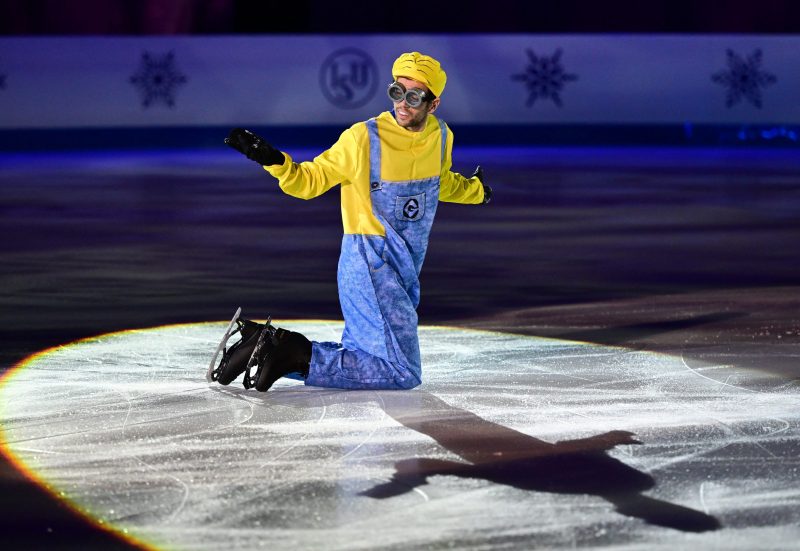
One of the several unusual storylines from Milano Cortina centers around Spanish skater Tomàs-Llorenç Guarino Sabaté. His short program is inspired by the Minions, using music from the 2015 animated movie, all while dressed like one of Gru’s chaotic henchmen.
It was expected to be a crowd favorite at the Olympics, but it was in jeopardy of not being performed due to music copyright issues. Sabaté publicly said on Monday, Feb. 2 the music wasn’t cleared to be used, just over one week before he was scheduled to perform.
The news drew outrage from the figure skating world, but also from skaters themselves, all who felt like they were being robbed of a must-see performance.
“I told people they were gonna see the minions of the Olympics, and I don’t want to be a liar,” U.S. figure skater Amber Glenn said.
Thankfully, figure skating fans weren’t upset for long. They rejoiced a few days later when Sabaté announced the music was cleared, meaning the Minions would make it to the rink.
This isn’t the biggest storyline in figure skating. It’s centered around bringing a fun, enticing program to the Olympics. But it highlights a larger issue that has plagued figure skating, despite attempts to fix it.
“It’s something that we kind of all worry about,” U.S. skater Ilia Malinin said. “I like to pick really unique pieces of music that I skate to, and there’s a lot of the challenges of whether people will like it, but also it’s whether you’ll be able to skate to it.”
Why music causes problems in figure skating
Coming up with the music for programs is already a challenging task. The whole program is built around it, finding the right medley and parts of songs that dictate choreography and costumes.
Then comes making sure the music is good to use. It had been a long process before where skaters had to figure out who owned the music, negotiate with them and pay to get permission. But that was when music was usually classical and instrumental.
It wasn’t until 2014 when the International Skating Union allowed music with lyrics it became a bigger problem. Artists and record labels own the songs and a license is needed from every song rightsholder.
Headaches throughout figure skating led to the ISU partnering with ClicknClear, a licensing platform that works with record labels and publishers to pre-clear music so it can easily be used, all that is needed to pay for it. Seems simple, but it still hasn’t fixed the problem.
The issue came to focus at the 2022 Winter Olympics, when music group Heavy Young Heathens sued NBC, U.S. Figure Skating and pair Alexa Knierim and Brandon Frazier, alleging they violated the copyright of the song ‘House of the Rising Sun.” The lawsuit was eventually settled.
“We have tried our hardest to get everything clear, do what we can, and honestly, a producer could just decide no … We don’t have 100,000% control,” Glenn said. “I’ve honestly just seen from what avenues I have available to me that it is clear, and then I’m just hoping and praying that I don’t get an email saying, ‘Oh, by the way, they reached out and they said they don’t want you to use it.’”
“It’s been a very strenuous process for many of us,” she added.
How Minions got approved for Olympics
The issue for Sabaté was the music was owned by Universal Pictures, which owns the rights to the Minions. The music was restricted and Sabaté’s team tried for individual one-off clearances, but got denied, ClicknClear founder Chantal Epps told USA TODAY Sports.
“Because of the increasing risk of using music unlicensed across figure skating and other sports, (Sabaté) and his federation made the decision to not proceed with the program, because obviously there’d have been some legal dispute,” Epps said.
Sabaté could have used an old program, but Epps said that music wasn’t cleared, so “it would have been just as much work, if not more, because we’d be starting from scratch.” Epps decided to get involved and work with Universal Pictures to get approval.
By Tuesday, Feb. 3, two of the songs were good to use. A third song was inputted in the system wrong and actually had clearance, so it was good. The last holdup was “Freedom” by Pharrell Williams, which Epps said took the longest to get because the master side of it is restricted under the deal with Sony.
“I went around on a wild goose chase trying to get through to the person who could actually give us approval, made a lot of calls,” Epps said. “It was approved by (Friday, Feb. 6) morning. I let Thomas know on Friday morning that it was all approved, and now the world is going to be very happy that we’re going to see Minions on the ice.”
A happy ending, but a roller coaster of a ride that shows how difficult it can be, and not everyone is as fortunate. Epps added the publicity from Sabaté helped in getting the approvals.
Glenn nearly had an issue for these Games. Her free skate includes the song ‘The Return’ by artist Seb McKinnon, and he posted on social media the song was used without his permission. However, Glenn had done the process correctly and McKinnon didn’t know his label approved the use. He congratulated her when he learned she earned team gold, and Glenn put out a statement on Feb. 10 that ‘sometimes new friendships start in unexpected ways.’
‘It was a dream come true to perform at the Olympic Games and to have Seb acknowledge my performance and congratulate me afterward made the moment even more special. It’s my sincere hope that I was able to help create new fans of both figure skating and Seb,’ she wrote.
How figure skaters try to avoid music problems
Some U.S. skaters have built-in ways to avoid issues. The main one is simply connecting with those who make the music, something Malinin makes it a point to do.
“I always try to reach out to whoever’s in charge of that decision for music, and especially, I like to reach out to the artist directly,” he said. “Try that as an option, and most of the time, it usually works out in my favor.”
Other examples include Alysa Liu, who skates her short program to “Promise” by Laufey. The reigning world champion has a public friendship with the artist, even connecting at one of Laufey’s concerts. After Liu skated the program in the team event on Friday, Feb. 6, Laufey posted a TikTok dedicated to the skater with the caption “that’s OUR olympian alysa liu.”
Glenn’s short program is to “Like a Prayer” by Madonna, and she hasn’t heard anything from the iconic artist. If Madonna decided to tell Glenn she didn’t want her to use the song, she wouldn’t see it as the worst thing.
“If I do get a message from Madonna saying she doesn’t want me to skate to her music, I mean, I’ll just be excited to get a message from Madonna,” Glenn joked.
It appears Glenn won’t have to worry about this one though, recently revealing Madonna follows her on Instagram.Safe to assume nearly all of the figure skating audience will enjoy watching Sabaté skate his program, knowing the fight it took to make it happen. Skaters around the world hope they won’t have to go through the same thing.
“You really don’t know what you’re getting into, but you kind of just have to hope everything works out,” Malinin said.
Get our Chasing Gold Olympics newsletter in your inbox for coverage of your favorite Team USA athletes