Alabama keeps losing after adding a low-scoring NBA G League player. That’s not karma. That’s just proof of failed desperation.
Alabama has one win and two losses after judge granted ruling in favor of Charles Bediako as he sues NCAA.
Nate Oats says he wants enforceable rules, while accepting player who sued the NCAA to sidestep its rules.

Florida coach Todd Golden could barely control his amusement as he read the stats aloud after his team’s 100-77 rout of Alabama.
“We beat them on the glass. We scored 72 points in the paint,” Golden said. “Our bigs were really, really good.”
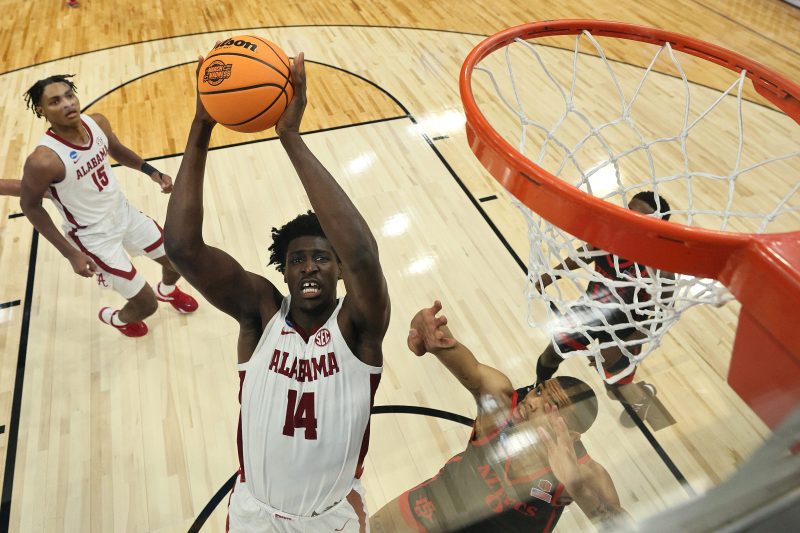
You say Alabama winning just once and losing twice after adding a G League player is a show of karma’s muscle. I say it’s proof Alabama needed to go bigger. Coach Nate Oats rocked the boat for a guy who scored six points, before fouling out against the Gators.
Charles Bediako to Alabama stunk of desperation
Oats’ grab of Bediako reeked of desperation. Turns out, a 23-year-old center who was averaging four points in the G League won’t cure all that ailed Alabama. He’s no threat to snatch away the Wooden Award.
Go big or go home, I say.
Is there no 31-year-old Serbian dominating in Europe who could be lured onto a college campus with a mega-millions NIL deal?
If you’re willing to challenge NCAA rules, why stop at Bediako? For a more transformative roster move, try Oscar Tshiebwe. A former Kentucky star who left UK with a year of eligibility remaining, the 26-year-old Tshiebwe leads the G League in rebounding.
NCAA rules prohibit Tshiebwe from playing again in college. NCAA rules also stood in the way of Bediako. So, Bediako got a lawyer.
“Wait a minute, are people allowed to go back to school?” Tshiebwe wrote on social media last month.
As with many eligibility questions in college sports, the courts will answer that.
Never mind Gen Ed coursework, having a lawyer on speed dial is the first thing college athletes must learn nowadays. Second thing you learn: Hope you draw a judge who supports the home team.
Bediako hadn’t played college hoops in nearly three years before an Alabama judge who’s listed as a Crimson Tide athletics donor awarded him the green light to suit up.
Bediako is scheduled for another hearing this week in front of a different judge, as his lawsuit against the NCAA proceeds.
Meanwhile, in the wake of the initial Bediako court ruling, former NBA player Amari Bailey hired a lawyer as he explores returning to college basketball.
NCAA rules prohibit eligibility for former college players with NBA experience, but you know the thing about NCAA rules? They’re ripe for a legal challenge.
Nate Oats follows four-step plan, while NCAA suffers
Four of Oats’ previous five teams advanced to at least the Sweet 16. This team, though, encountered persistent frontcourt deficiencies and struggled on defense. It lost two of its first three SEC games.
That helps explain why Oats looked to the G League for answers, shortly after he got on a soapbox about college teams adding international players with overseas pro experience.
In Bediako, Oats added a new page to the desperate coaches playbook: Bring back a college player who declared for the NBA draft nearly three years ago.
In doing so, Oats adhered to the four-step plan running wild and free within Division I coaching.
Step 1: Tsk, tsk the state of college sports.
Step 2: Find a way to further circumvent the rules. Usually, this step involves a lawyer.
Step 3: Say something like, “Hey, don’t blame me. Blame the system.”
Step 4: Bemoan the lack of enforceable rules and pretend you wish there were stronger guardrails.
On cue, Oats deployed Step 4 after the Florida game, when asked whether he’s concerned about the slippery slope of pro players playing for college teams.
“They need to come up with a set of rules that everybody agrees on and we follow,” said Oats, who added the NCAA needs rules that can withstand legal challenges.
Fact-check: The NCAA has rules to which its membership agrees. Then, members continually look to sidestep or legally challenge NCAA rules, when convenient.
As Oats points out, numerous college rosters feature international players with pro experience in foreign leagues. The NCAA permits this. Bediako is also not the first college player with G League experience.
Baylor, earlier this season, added Nigerian-born James Nnaji, a former NBA draft pick who played professionally in Europe. He’s averaging a whopping 1.2 points for Baylor.
Bediako, according to Oats, is a dual citizen in America and Canada.
Oats’ logic: If expats who played professionally in international leagues can suit up in college, then why can’t an American who played in the G League return to Alabama?
“Some people would argue that Charles has a better case to be eligible than some other guys playing in college basketball,” Oats said.
Not sure that argument holds up, upon scrutiny. Bediako left Alabama for the pros knowing NCAA rules dictate he’d surrender his remaining college basketball eligibility.
When, three years into his pro career, he decided he wanted to rejoin Alabama’s team, he sued the NCAA.
Bediako might win in court, but the Gators served him humble pie.
Six points. Five fouls. From a pro player. Alabama lost again and dropped from the polls.
That’s not karma. That’s proof that, even after desperately adding a ‘G League dropout,’ the team Oats built remains insufficient and incomplete.
Blake Toppmeyer is a sports columnist for the USA TODAY Network. Email him at BToppmeyer@gannett.com and follow him on X @btoppmeyer.