MILAN — For most of the 21st century, U.S. pairs figure skating has been an afterthought.

While the men, women and ice dance sent three representatives in their respective disciplines, it became the norm to just send two pairs. Even then, they weren’t really medal favorites. It was never something Team USA boasted.
But things appear to be changing in the right direction.
While not quiet podium contenders, the teams of Ellie Kam and Danny O’Shea with Emily Chan and Spencer Akira Howe showed the American pairs division is on the rise, starting the short program on a strong note to set up what could be a milestone finish.
Team USA’s night on Sunday, Feb. 15 began with a team that technically got in thanks to some lucky breaks. National champions Alisa Efimova and Misha Mitrofanov, as well as third-place finishers Katie McBeath and Daniil Parkman, couldn’t qualify for the Olympics due to citizenship issues, opening the door for the fourth-place finishers in Chan and Howe.
It was at the U.S. figure skating championships where the two had a rough short program, riddled with mistakes that almost took them out of Olympic contention immediately. Clearly, a month of preparation helped.
There was a night-and-day difference in their performance, highlighted by a dazzling triple toe loop. Even better, no mess-ups.
“It was a bit of a sigh of relief and just excitement,” Chan said of her reaction when the program was finished. “We really went out there and we were together, and we experienced that whole entire program together. I just felt on the top of the mountain.”
Chan and Howe earned a score of 70.06, more than 10 points of what they got in the same program one month ago. It earned praise from 2006 ice dance medalist Ben Agosto, telling the crowd inside Milano Ice Skating Arena it was the “best I’ve seen them in a long time.”
“A big goal has always just been getting out there and feeling good, because if you can feel good, then you have your best chances of delivering what you need to do,” Howe said. “I just felt really laser focused out there.”
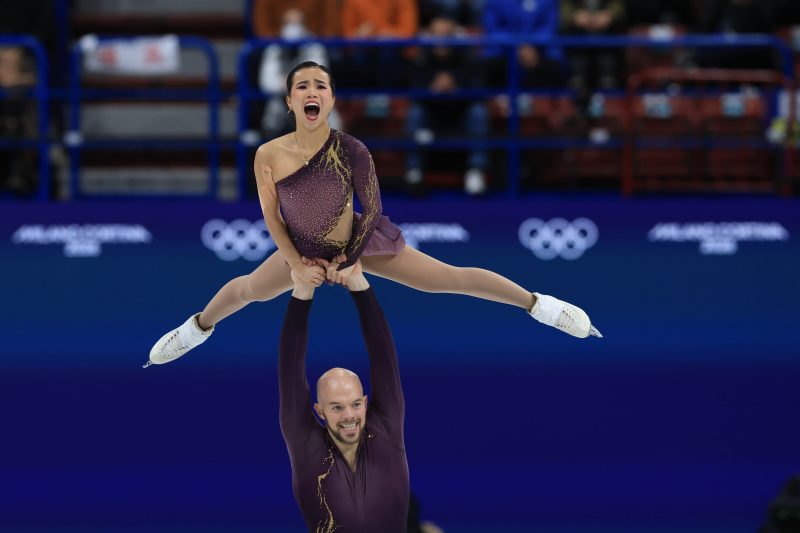
That set it up for the team event’s unsung heroes. After playing a critical role in the U.S. winning gold, Kam and O’Shea rode the wave from a week ago. However, the short program in the team event was tough since Kam fell on the throw triple loop.
Since winning gold, they spent time away from the Olympic Village to pull the emotions together, but keep the good vibes going.
This time around, there was no hitting the ice. Kam was able to keep her balance on the throw, proof their plan worked.
“It feels like we were able to keep all the good momentum and the good things that we wanted to take from the team event and leave all the rest that we didn’t need behind,” she said.
Despite some minor self-inflicted mistakes from O’Shea, the pair didn’t just get a better score than the team event. They got a season-best 71.87.
“We definitely had a little more jitters,” O’Shea recalled of their first outing. “Since then, we’ve been able to settle in and really reframe and refocus on having the time of our lives.
“The performance itself is something we’re really proud of,” he added. “We stayed on our feet, got rid of those bigger mistakes and got a season’s best.”
Improvement in US figure skating pairs
Heading into the free skate, Kam and O’Shea are in seventh place with Chan and Howe in ninth. It may not seem impressive, but it marks quite the accomplishment. With the 2022 Games, the U.S. has now had two pairs in the top 10 of the standings after the short program in back-to-back Olympics for the first time in the 21st century.
O’Shea credited Alexa Knierim and Brandon Frazier, whose sixth place finish in 2022 was Team USA’s best since 2002, for opening the door for improvement in the category, and frankly, the reason he and Kam are now partners.
“We’re only getting better,” she said.
Now, the U.S. can complete it in the free dance by having two top 10 finishers in back-to-back Olympics for the first time this century. It’s nothing to brag about, but it shows there’s an upward trend for a discipline that’s been desperately looking for one for decades.
Will either team snap the skid and be the first American pair to win an Olympic medal since 1988? Not likely, but given how unpredictable figure skating has gone in Milano Cortina, including in the pairs, nothing can be entirely ruled out.
Medal or not, the two teams are proving there’s a resurgence in pairs, and it may be a few Olympics away from finally standing on that podium once again.
“I’m so proud of what the pairs in the US have been doing,” O’Shea said. “We really hope to keep that tradition going.”